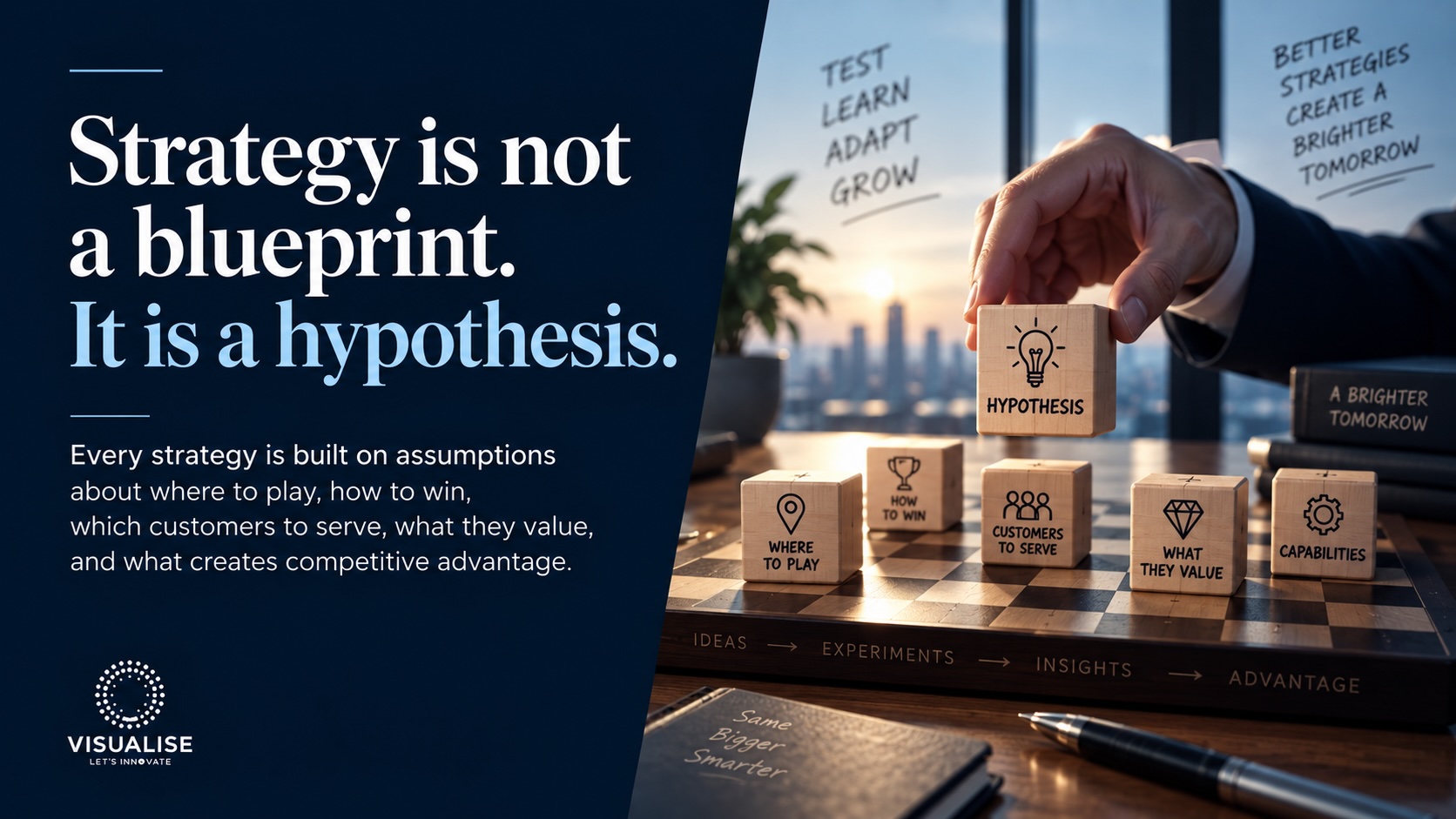


Many organisations confuse strategy with planning, ambition, or a list of initiatives. Yet, true strategic thinking demands clarity, discipline, and a deep understanding of choice and positioning. Drawing from the seminal frameworks of Michael Porter, Roger Martin, Richard Rumelt, Henry Mintzberg, and Kaplan & Norton, this article synthesises the core principles of effective strategy design and execution.
Michael Porter: The Discipline of Competitive Advantage
Michael Porter, one of the most influential thinkers in competitive strategy, reframes strategy as a discipline rooted in differentiation and trade-offs. His central insight: competing to be the best is a race to the bottom — the goal is to be different.
Porter challenges leaders to answer foundational questions:
- What is our unique competitive position? → What value do we deliver that others can’t or won’t?
- What is our value proposition? → Who are our target customers, what needs do we serve, and at what price?
- What makes our activities different? → How are we configured differently from rivals to deliver that value?
- What trade-offs are we willing to make? → What will we not do — which customers, needs, or products will we intentionally ignore?
- How does our activity fit to reinforce our advantage? → Are our choices coherent and mutually reinforcing, or simply a list of unconnected moves?

Porter’s framework teaches that strategy is about choosing what not to do, and building systems of activities that fit together to sustain competitive advantage.
Roger Martin & A.G. Lafley: Strategy as a Set of Choices
In Playing to Win, Roger Martin and former P&G CEO A.G. Lafley define strategy not as a plan, but as a cascade of interlocking choices made under uncertainty.
Their strategic logic rests on five key questions:
- What is our winning aspiration? → What does success look like — and why does it matter?
- Where will we play? → Which markets, segments, or geographies will we serve?
- How will we win? → What is our advantage — cost leadership, differentiation, or something else?
- What capabilities must we have? → What do we need to be exceptionally good at?
- What systems must be in place? → How will we support execution, measurement, and continuous improvement?
By focusing on deliberate choice, Martin and Lafley elevate strategy from theoretical ambition to practical commitment.
Richard Rumelt: The Kernel of Good Strategy
Richard Rumelt offers a sobering view of strategy’s frequent misuse. In Good Strategy, Bad Strategy, he asserts: if you can’t define the problem, you don’t have a strategy.
His “Kernel of Good Strategy” includes:
- Diagnosis: → What is the real challenge we face? Avoid mistaking symptoms for root causes.
- Guiding Policy: → What broad approach will we adopt to tackle the challenge?
- Coherent Actions: → What specific and coordinated initiatives will bring the strategy to life?

Rumelt warns against “fluff” — vague goals disguised as strategy — and emphasises clarity, focus, and leverage.
Henry Mintzberg: Strategy as Practice and Emergence
Henry Mintzberg shifts the lens from strategy as design to strategy as experience and practice. For him, strategy emerges over time through real-world actions.
Key questions he poses:
- What patterns are emerging in our actions? → What are we doing — not just what’s written in strategic plans?
- How do deliberate and emergent strategies interact? → How do we adapt to surprises, setbacks, and shifting realities?
- Who shapes strategy in practice? → Beyond the boardroom, how do teams and managers contribute?
Mintzberg’s insight is a powerful reminder: strategy is as much learned as it is planned, and adaptability is a strategic asset.
Kaplan & Norton: Strategy Execution through the Balanced Scorecard
Bob Kaplan and David Norton focus on bridging the gap between strategy and execution. Their Balanced Scorecard helps organisations translate vision into operational objectives.
They emphasise:
- Clear strategic objectives: → Defined through financial, customer, process, and learning lenses.
- Cause-and-effect logic: → Identifying how actions today impact long-term results.
- Strategic alignment: → Ensuring all departments and teams pull in the same direction.
Execution is where many strategies fail — and Kaplan & Norton provide a system for turning plans into measurable progress.
The Seven Universal Strategy Questions
By integrating these diverse but complementary perspectives, we arrive at a unifying framework. Strategy, at its core, is about clarifying purpose, making hard choices, and aligning efforts.
Here are the seven master questions that define a strong strategy:
- What are we trying to achieve — and why does it matter? (Aspiration)
- Where will we compete? (Arena/market choice)
- How will we win? (Source of advantage)
- What will we not do? (Trade-offs)
- What must we be great at? (Capabilities)
- What systems, structures, and culture support execution? (Alignment)
- How will we know we’re succeeding? (Measurement & learning)
From Theory to Action
Strategy is not reserved for Fortune 500 companies or MBA case studies — it’s essential for every organisation aiming to grow, differentiate, and thrive under uncertainty. Whether you’re crafting a startup strategy, reshaping a legacy business, or guiding a nonprofit, these timeless principles offer a robust foundation.
To further explore strategic frameworks, execution models, and tools that clarify your thinking, Visualise Solutions offers resources to help teams align, execute, and win in complex environments.